
The Story of Joseph and His Brothers
Today I want to share with you "The Story of Joseph and His Brothers" – one of the most exciting stories in the Bible filled with dreams, jealousy, a beautiful coat, and amazing forgiveness. This story shows how God can take something meant for harm and turn it into something wonderful!
I love telling this story because it has everything – family drama, adventures in a faraway land, mysterious dreams, and a surprise ending that will leave you amazed. Let's jump into this incredible story about a young dreamer who became one of the most powerful men in the ancient world!
- Download Joseph's Journey from Betrayal to Redemption Infographics
- The Story of Joseph and His Brothers
- Chapter 1: The Favored Son
- Chapter 2: The Dreamer
- Chapter 3: The Plot Against Joseph
- Chapter 4: Sold Into Slavery
- Chapter 5: The Deception
- Chapter 6: From Slave to Servant
- Chapter 7: False Accusations
- Chapter 8: The Prison Interpreter
- Chapter 9: Pharaoh's Dreams
- Chapter 10: From Prisoner to Prime Minister
- Chapter 11: The Brothers Journey to Egypt
- Chapter 12: Joseph Tests His Brothers
- Chapter 13: The Silver Cup
- Chapter 14: Joseph Reveals His Identity
- Chapter 15: The Family Reunited
- What Can We Learn From The Story of Joseph and His Brothers?
- Joseph's Journey: From Betrayal to Forgiveness
- Trivia Quiz About Joseph for Kids
Download Joseph's Journey from Betrayal to Redemption Infographics
Explore Joseph’s inspiring story of resilience and faith through our infographic, from betrayal to redemption!" for a few seconds

The Story of Joseph and His Brothers
Chapter 1: The Favored Son
Joseph was the eleventh son of Jacob (who was also called Israel). Unlike his older brothers, Joseph was born to Rachel, Jacob's favorite wife, when Jacob was already an old man. Because of this, Jacob loved Joseph more than all his other children.
To show his special love, Jacob gave Joseph a beautiful coat of many colors – a richly ornamented robe that made Joseph stand out from all his brothers. This obvious favoritism made Joseph's brothers extremely jealous and bitter towards him.

Genesis 37:3-4 tells us, "Now Israel loved Joseph more than any of his other sons, because he had been born to him in his old age; and he made an ornate robe for him. When his brothers saw that their father loved him more than any of them, they hated him and could not speak a kind word to him."
Chapter 2: The Dreamer
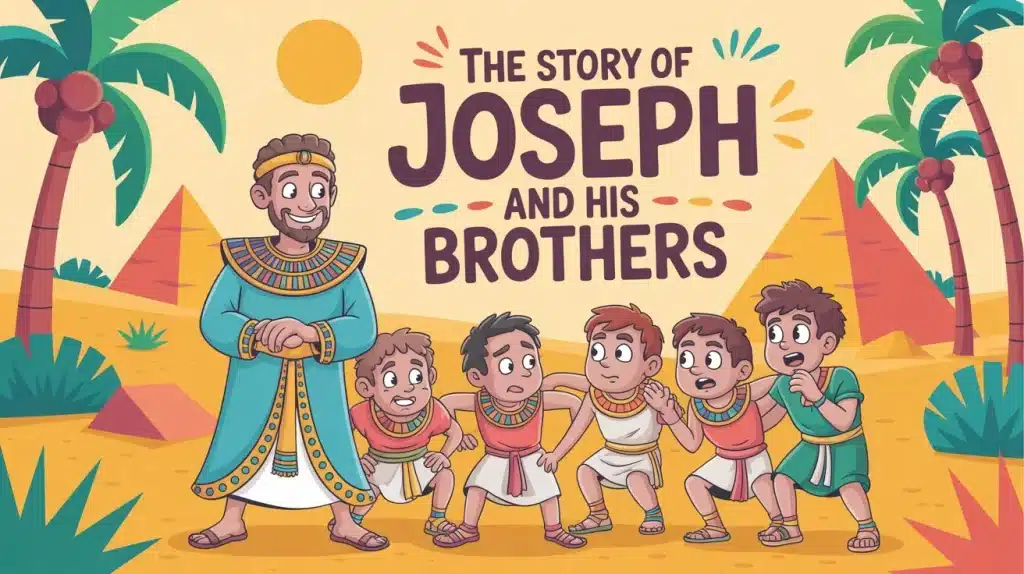
To make matters worse, Joseph started having unusual dreams that seemed to suggest that one day his entire family would bow down to him. Instead of keeping these dreams to himself, he excitedly shared them with his already jealous brothers.
In one dream, Joseph and his brothers were binding sheaves of grain in a field when suddenly Joseph's sheaf stood upright and all his brothers' sheaves gathered around and bowed down to his sheaf. In another dream, the sun, moon, and eleven stars bowed down to Joseph.
When Joseph told his family about these dreams, even his father rebuked him. Genesis 37:10-11 records Jacob's reaction: "His father rebuked him and said, 'What is this dream you had? Will your mother and I and your brothers actually come and bow down to the ground before you?' His brothers were jealous of him, but his father kept the matter in mind."
Chapter 3: The Plot Against Joseph
One day, when Joseph was seventeen years old, Jacob sent him to check on his brothers who were tending their flocks far from home. When the brothers saw Joseph coming across the field wearing his special coat, their hatred overflowed.
First, they plotted to kill him, saying, "Here comes that dreamer! Come now, let's kill him and throw him into one of these cisterns and say that a fierce animal devoured him. Then we'll see what comes of his dreams!"
But Reuben, the oldest brother, didn't want Joseph's blood on their hands, so he suggested they throw Joseph into a cistern (a deep pit for storing water) instead, secretly planning to rescue him later.
Genesis 37:23-24 describes what happened next: "So when Joseph came to his brothers, they stripped him of his robe—the ornate robe he was wearing—and they took him and threw him into the cistern. The cistern was empty; there was no water in it."
Chapter 4: Sold Into Slavery

After throwing Joseph into the pit, the brothers sat down to eat a meal. While they were eating, they spotted a caravan of Ishmaelite traders heading to Egypt with camels carrying spices, balm, and myrrh.
Judah, another of Joseph's brothers, had an idea. Instead of leaving Joseph to die in the pit, why not sell him to these traders? This way, they could get rid of him and make some money at the same time – without directly killing him.
Genesis 37:26-27 records Judah's suggestion: "Judah said to his brothers, 'What will we gain if we kill our brother and cover up his blood? Come, let's sell him to the Ishmaelites and not lay our hands on him; after all, he is our brother, our own flesh and blood.' His brothers agreed."
So they pulled Joseph out of the cistern and sold him for twenty pieces of silver to the Ishmaelite merchants, who took him to Egypt. Reuben, who had been away, returned to find Joseph gone and was devastated that his plan to rescue his brother had failed.
Chapter 5: The Deception
Now the brothers had to explain Joseph's disappearance to their father. They took Joseph's beautiful coat, dipped it in goat's blood, and brought it back to Jacob, asking, "We found this. Examine it to see whether it is your son's robe."
Jacob recognized it immediately and concluded that Joseph had been killed by a wild animal. He tore his clothes, put on sackcloth, and mourned for his son for many days. He refused to be comforted, saying, "In mourning will I go down to the grave to my son."
Genesis 37:33-34 describes Jacob's grief: "He recognized it and said, 'It is my son's robe! Some ferocious animal has devoured him. Joseph has surely been torn to pieces.' Then Jacob tore his clothes, put on sackcloth and mourned for his son many days."
Chapter 6: From Slave to Servant

Meanwhile, the Midianite merchants arrived in Egypt and sold Joseph to Potiphar, one of Pharaoh's officials, the captain of the guard. Despite being far from home and sold as a slave, Joseph did not give up hope or faith in God.
Joseph worked diligently in Potiphar's house, and God was with him, making him successful in everything he did. Potiphar noticed this and put Joseph in charge of his entire household and everything he owned.
Genesis 39:4-5 tells us: "Joseph found favor in his eyes and became his attendant. Potiphar put him in charge of his household, and he entrusted to his care everything he owned. From the time he put him in charge of his household and of all that he owned, the Lord blessed the household of the Egyptian because of Joseph."
Chapter 7: False Accusations
Joseph was handsome and well-built, and after some time, Potiphar's wife began to notice him. She tried repeatedly to seduce Joseph, but he refused her advances, saying he wouldn't betray Potiphar's trust or sin against God.
One day, when no one else was around, Potiphar's wife grabbed Joseph by his cloak and demanded, "Come to bed with me!" Joseph ran away, leaving his cloak in her hands. Furious at being rejected, she used the cloak as evidence to falsely accuse Joseph of attacking her.
When Potiphar heard this story, he was angry and had Joseph thrown into the king's prison. Even in this terrible situation, God remained with Joseph. Genesis 39:20-21 says, "Joseph's master took him and put him in prison, the place where the king's prisoners were confined. But while Joseph was there in the prison, the LORD was with him."
Chapter 8: The Prison Interpreter
In prison, Joseph quickly gained the trust of the prison warden, who put him in charge of all the prisoners. Two of Pharaoh's officials – the chief cupbearer and the chief baker – were also imprisoned, and one night they both had troubling dreams.
When Joseph saw them looking sad the next morning and learned about their dreams, he said, "Do not interpretations belong to God? Tell me your dreams." The cupbearer dreamed of a vine with three branches that budded, blossomed, and produced grapes which he squeezed into Pharaoh's cup. Joseph interpreted this to mean that in three days, the cupbearer would be restored to his position.
The baker dreamed of three baskets of bread on his head, with birds eating from the top basket. Joseph interpreted this to mean that in three days, the baker would be executed. Both interpretations came true exactly as Joseph had said. Joseph asked the cupbearer to remember him when he was restored, but the cupbearer forgot about Joseph for two full years.
Chapter 9: Pharaoh's Dreams
Two years later, Pharaoh himself had two troubling dreams that none of his magicians or wise men could interpret. In his dreams, seven fat, healthy cows came up from the Nile River, followed by seven ugly, thin cows that ate the seven healthy ones. In his second dream, seven healthy heads of grain were swallowed up by seven thin, scorched heads.
Finally, the chief cupbearer remembered Joseph and told Pharaoh how Joseph had correctly interpreted his dream in prison. Pharaoh immediately sent for Joseph, who was brought from the dungeon, cleaned up, and presented before the king.
When Pharaoh described his dreams, Joseph gave God the credit for the interpretation: "I cannot do it, but God will give Pharaoh the answer he desires." Then Joseph explained that the dreams were warnings from God that Egypt would have seven years of abundant harvests followed by seven years of severe famine.
Genesis 41:25-27 records Joseph's interpretation: "The dreams of Pharaoh are one and the same. God has revealed to Pharaoh what he is about to do. The seven good cows are seven years, and the seven good heads of grain are seven years; it is one and the same dream. The seven lean, ugly cows that came up afterward are seven years, and so are the seven worthless heads of grain scorched by the east wind: They are seven years of famine."
Chapter 10: From Prisoner to Prime Minister
Joseph didn't just interpret the dreams; he also offered Pharaoh a wise solution: appoint a wise administrator to collect one-fifth of all produce during the seven good years and store it for the coming famine. Pharaoh was so impressed with Joseph's wisdom that he appointed Joseph himself to this important position.
In a dramatic reversal of fortune, Joseph went from being a prisoner to becoming the second most powerful man in Egypt, answerable only to Pharaoh himself. Pharaoh gave Joseph his signet ring, dressed him in fine linen, put a gold chain around his neck, and gave him a new Egyptian name and a wife.
Genesis 41:41-43 describes this transformation: "So Pharaoh said to Joseph, 'I hereby put you in charge of the whole land of Egypt.' Then Pharaoh took his signet ring from his finger and put it on Joseph's finger. He dressed him in robes of fine linen and put a gold chain around his neck. He had him ride in a chariot as his second-in-command, and people shouted before him, 'Make way!' Thus he put him in charge of the whole land of Egypt."
Chapter 11: The Brothers Journey to Egypt
Just as Joseph had predicted, seven years of abundance were followed by a severe famine that affected all the surrounding countries, including Canaan, where Jacob and his family lived. When they ran out of food, Jacob heard that Egypt had grain and sent ten of his sons there to buy food, keeping only Benjamin (Joseph's full brother) at home for safety.
When the brothers arrived in Egypt, they had to appear before Joseph, who was in charge of selling grain. Joseph recognized them immediately, but they didn't recognize him – after all, it had been over 20 years, and Joseph now looked, dressed, and spoke like an Egyptian.
Genesis 42:7-8 tells us: "As soon as Joseph saw his brothers, he recognized them, but he pretended to be a stranger and spoke harshly to them. 'Where do you come from?' he asked. 'From the land of Canaan,' they replied, 'to buy food.' Although Joseph recognized his brothers, they did not recognize him."
Chapter 12: Joseph Tests His Brothers
Joseph decided to test his brothers to see if they had changed. He accused them of being spies and put them in prison for three days. Then he released them but kept one brother, Simeon, as a hostage. He told the others to go home and bring back their youngest brother to prove they were telling the truth.
Joseph also secretly returned their money in their grain sacks, which frightened them when they discovered it later. The brothers were troubled by all this and told their father what had happened. Jacob was distressed and refused to let Benjamin go to Egypt, saying, "My son will not go down there with you. His brother is dead, and he is the only one left."
However, as the famine grew worse, Jacob eventually had no choice but to send Benjamin to Egypt with his brothers, along with a gift of local products and double the money to return what had mysteriously appeared in their sacks.
Chapter 13: The Silver Cup
When the brothers returned to Egypt with Benjamin, Joseph invited them to a meal at his house. He was deeply moved when he saw Benjamin but had to leave the room to weep privately. During the meal, Joseph gave Benjamin five times as much food as the others, watching to see if they would be jealous.
The next morning, as they started their journey home, Joseph had his steward plant his personal silver cup in Benjamin's sack and then sent the steward after them to accuse them of theft. When the cup was found in Benjamin's sack, the brothers were devastated and returned to the city.
Through his interpreter, Joseph declared that the one found with the cup – Benjamin – would remain as his slave, but the others could go free. At this point, Judah stepped forward and gave an impassioned plea, explaining how the loss of Benjamin would kill their elderly father. He offered himself as a slave in Benjamin's place.
Genesis 44:33-34 records Judah's moving offer: "Now then, please let your servant remain here as my lord's slave in place of the boy, and let the boy return with his brothers. How can I go back to my father if the boy is not with me? No! Do not let me see the misery that would come on my father."
Chapter 14: Joseph Reveals His Identity
Judah's selfless offer showed Joseph that his brothers had truly changed. Unable to control his emotions any longer, Joseph ordered everyone except his brothers to leave the room. Then he broke down weeping so loudly that the Egyptians outside could hear him.
Through his tears, Joseph finally revealed the truth: "I am Joseph! Is my father still living?" His brothers were terrified and couldn't answer him. Joseph told them to come closer and assured them, "I am your brother Joseph, the one you sold into Egypt!"
Instead of seeking revenge, Joseph showed remarkable forgiveness and perspective. Genesis 45:5-8 records his amazing words: "And now, do not be distressed and do not be angry with yourselves for selling me here, because it was to save lives that God sent me ahead of you. For two years now there has been famine in the land, and for the next five years there will be no plowing and reaping. But God sent me ahead of you to preserve for you a remnant on earth and to save your lives by a great deliverance. So then, it was not you who sent me here, but God."
Chapter 15: The Family Reunited
Joseph told his brothers to hurry back to Canaan and bring their father and all their families to Egypt, where Joseph could provide for them during the five remaining years of famine. He gave them wagons, supplies for the journey, new clothes, and gifts, sending them off with the instruction, "Don't quarrel on the way!"
When they returned home and told Jacob, "Joseph is still alive! In fact, he is ruler of all Egypt," Jacob was stunned and at first didn't believe them. But when he saw the wagons Joseph had sent to carry him back, Jacob's spirit revived.
Genesis 46:29-30 describes the emotional reunion: "Joseph had his chariot made ready and went to Goshen to meet his father Israel. As soon as Joseph appeared before him, he threw his arms around his father and wept for a long time. Israel said to Joseph, 'Now I am ready to die, since I have seen for myself that you are still alive.'"
Joseph settled his family in the region of Goshen, where they prospered and multiplied. Jacob lived in Egypt for seventeen years before he died at the age of 147, after blessing Joseph's sons and all his own sons.
What Can We Learn From The Story of Joseph and His Brothers?
- God has a bigger plan - Even when terrible things happen to us, God can work them out for good. Joseph told his brothers, "You meant evil against me, but God meant it for good."
- Forgiveness brings healing - Joseph chose to forgive his brothers rather than seek revenge, bringing healing to his whole family instead of more pain.
- Patience in hardship - Joseph remained faithful to God through slavery, false accusations, and prison, showing us how to trust God even in unfair situations.
- God uses dreams and gifts - Joseph's ability to interpret dreams was a gift from God that eventually saved many lives. Our special abilities can be used by God too!
- Family relationships matter - This story shows both the damage that favoritism and jealousy can cause in families and how reconciliation is possible even after terrible hurts.
Joseph's Journey: From Betrayal to Forgiveness

Trivia Quiz About Joseph for Kids
How many brothers did Joseph have?
Joseph had eleven brothers, making twelve sons of Jacob in total. Together they became the heads of the twelve tribes of Israel.
What special gift did Jacob give to Joseph?
Jacob gave Joseph a richly ornamented coat of many colors, which was a sign of his special love for Joseph and made his brothers jealous.
How much money did Joseph's brothers receive when they sold him?
Joseph's brothers sold him to the Ishmaelite merchants for twenty pieces of silver, showing how little they valued their own brother.
What position did Joseph eventually hold in Egypt?
Joseph became the second-in-command in all of Egypt, answerable only to Pharaoh himself. He controlled all the food distribution during the seven-year famine.
How did Joseph test his brothers when they came to Egypt?
Joseph tested his brothers by hiding his silver cup in Benjamin's sack, then threatening to keep Benjamin as a slave, to see if they would protect their youngest brother or abandon him.
If you enjoyed the story of Joseph and his brothers, you might also like to hear about "Moses and the Exodus" - another exciting story about how God rescued the Israelites (Joseph's descendants) from slavery in Egypt many years later!

Leave a Reply
Related Posts