
The Story of Nehemiah in the Bible
The remarkable journey of Nehemiah unfolds across the pages of the Old Testament, revealing a man whose heart broke for his homeland. His story shows how one person's dedication can rebuild not just walls, but restore hope and faith to an entire community.
From a comfortable position in a foreign palace to the rubble-strewn streets of Jerusalem, Nehemiah's journey reminds us that sometimes God calls us to leave our comfort zones to accomplish extraordinary things.
- The Story of Nehemiah in the Bible
- Chapter 1: A Burden for Jerusalem
- Chapter 2: From Cupbearer to Builder
- Chapter 3: Organizing the Work
- Chapter 4: Facing Opposition
- Chapter 5: Internal Challenges
- Chapter 6: Completing the Wall
- Chapter 7: Establishing Order
- Chapter 8: Spiritual Renewal
- Chapter 9: Confession and Covenant
- Chapter 10: Practical Commitments
- What Can We Learn About Nehemiah?
- Trivia Quiz about Nehemiah for Kids
- What was Nehemiah's job before he went to Jerusalem?
- How long did it take to rebuild the walls of Jerusalem?
- Who were two of Nehemiah's main enemies who tried to stop the rebuilding?
- How did the workers protect themselves while building the wall?
- What did Nehemiah encourage the people to do when they wept after hearing God's law?
The Story of Nehemiah in the Bible
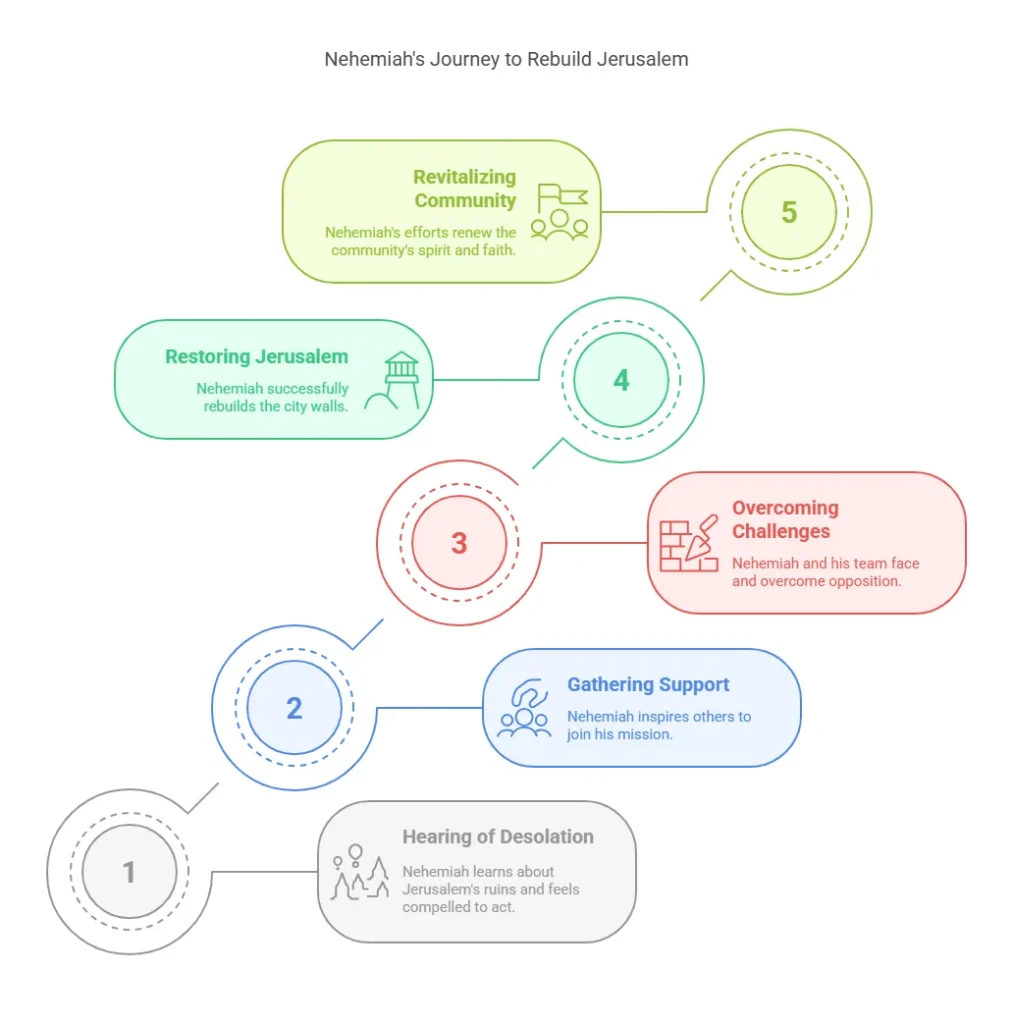
Chapter 1: A Burden for Jerusalem
While serving as cupbearer to King Artaxerxes in Persia, Nehemiah received devastating news about his homeland. His brother Hanani reported that "the wall of Jerusalem is broken down, and its gates have been burned with fire" (Nehemiah 1:3). This news broke Nehemiah's heart, moving him to deep mourning and prayer.
Nehemiah's response reveals his character—he immediately turned to God. "When I heard these things, I sat down and wept. For some days I mourned and fasted and prayed before the God of heaven" (Nehemiah 1:4). His heartfelt prayer acknowledged God's faithfulness and confessed the sins of his people, demonstrating his spiritual maturity and connection to his heritage.
Chapter 2: From Cupbearer to Builder

For four months, Nehemiah carried his burden silently while continuing his royal duties. Then one day, the king noticed his sadness. When asked about his downcast appearance, Nehemiah took a courageous step of faith and shared his heart's desire to rebuild Jerusalem.
Remarkably, the king not only granted Nehemiah permission to go but also provided letters of safe passage and materials for construction. Nehemiah 2:8 reveals the source of this favor: "And because the gracious hand of my God was on me, the king granted my requests." With royal backing, Nehemiah journeyed to Jerusalem to begin the seemingly impossible task of rebuilding.
Chapter 3: Organizing the Work
Upon arriving in Jerusalem, Nehemiah first conducted a nighttime inspection of the broken walls. His strategic planning began immediately as he assessed the damage before sharing his vision with the local leaders. "Then I said to them, 'You see the trouble we are in: Jerusalem lies in ruins, and its gates have been burned with fire. Come, let us rebuild the wall of Jerusalem, and we will no longer be in disgrace'" (Nehemiah 2:17).
Nehemiah's organizational skills shine in chapter 3, where he divided the wall into sections, assigning specific portions to families and groups. From the High Priest to goldsmiths, perfume makers to district rulers—everyone had a role. This clever approach of having people work near their homes increased motivation and efficiency, showing Nehemiah's wisdom as a leader.
Chapter 4: Facing Opposition
No good work goes unchallenged. As construction began, opponents emerged. Sanballat, Tobiah, and others first used mockery and ridicule, saying, "What are those feeble Jews doing? Will they restore their wall? Will they offer sacrifices? Will they finish in a day? Can they bring the stones back to life from those heaps of rubble—burned as they are?" (Nehemiah 4:2).
When ridicule failed to stop the progress, the opposition escalated to threats of attack. Nehemiah's response was two-fold: prayer and preparation. "We prayed to our God and posted a guard day and night to meet this threat" (Nehemiah 4:9). Workers began building with one hand while holding a weapon in the other—a powerful image of persistence through adversity.
Chapter 5: Internal Challenges
External opposition wasn't Nehemiah's only challenge. Internal problems arose when poorer Jews complained about exploitation by their wealthier countrymen. Some had mortgaged their fields and vineyards to buy food during a famine, while others had borrowed money for taxes, leading to a crisis where children were being sold into slavery.
Nehemiah confronted this injustice directly: "What you are doing is not right. Shouldn't you walk in the fear of our God to avoid the reproach of our Gentile enemies?" (Nehemiah 5:9). His personal example of forgoing his governor's allowance to ease the burden on the people demonstrated true servant leadership and a commitment to justice.
Chapter 6: Completing the Wall
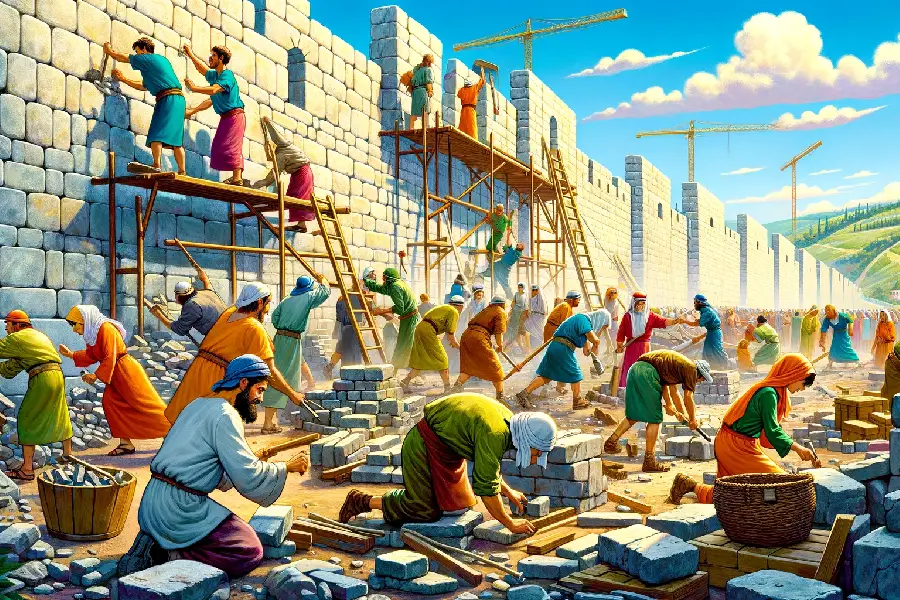
As the wall neared completion, Nehemiah's enemies made desperate attempts to derail the project. They invited him to meetings in distant villages—thinly veiled traps. Later, they sent an open letter falsely accusing him of planning rebellion against the king.
Nehemiah's focused response reveals his discernment: "I am carrying on a great project and cannot go down. Why should the work stop while I leave it and go down to you?" (Nehemiah 6:3). Despite intimidation, false prophecies, and continued opposition, the wall was completed in just 52 days. Nehemiah 6:16 records the result: "When all our enemies heard about this, all the surrounding nations were afraid and lost their self-confidence, because they realized that this work had been done with the help of our God."
Chapter 7: Establishing Order
With the physical barrier rebuilt, Nehemiah turned his attention to establishing order and security. He appointed trustworthy leaders, including his brother Hanani, to oversee Jerusalem's affairs. His instructions were specific: "The gates of Jerusalem are not to be opened until the sun is hot. While the gatekeepers are still on duty, have them shut the doors and bar them" (Nehemiah 7:3).
Nehemiah also organized a census of the returned exiles, meticulously recording genealogies to confirm who truly belonged to the community of Israel. This administrative work might seem less dramatic than wall-building, but it was essential for creating stability and preserving identity.
Chapter 8: Spiritual Renewal
Physical construction was only part of Nehemiah's mission. True restoration required spiritual rebuilding as well. Ezra the scribe played a crucial role in this phase, reading the Law of Moses to all the people gathered in the square before the Water Gate.
"They read from the Book of the Law of God, making it clear and giving the meaning so that the people understood what was being read" (Nehemiah 8:8). When the people heard God's word, they wept, but Nehemiah encouraged them: "Go and enjoy choice food and sweet drinks, and send some to those who have nothing prepared. This day is holy to our Lord. Do not grieve, for the joy of the LORD is your strength" (Nehemiah 8:10). This balance of reverence and rejoicing marked the beginning of spiritual renewal.
Chapter 9: Confession and Covenant

Following the Festival of Booths, the Israelites gathered for a solemn assembly of confession. For a quarter of the day, they listened to the reading of the Law, and for another quarter, they confessed their sins and worshiped God. The Levites led an extensive prayer recounting God's faithfulness throughout Israel's history, contrasted with the people's repeated disobedience.
This national examination of conscience led to a renewed covenant with God. "In view of all this, we are making a binding agreement, putting it in writing, and our leaders, our Levites and our priests are affixing their seals to it" (Nehemiah 9:38). Their collective commitment to follow God's laws represented the spiritual wall Nehemiah had helped rebuild.
Chapter 10: Practical Commitments
The renewed covenant included specific, practical commitments. The people pledged not to intermarry with surrounding nations, to honor the Sabbath by not conducting business, to bring the firstfruits of their harvests to God's house, and to support the temple ministry through tithes and offerings.
They declared, "We will not neglect the house of our God" (Nehemiah 10:39). These concrete actions demonstrated that their renewed faith wasn't just emotional or theoretical—it would change how they lived daily. Nehemiah understood that lasting change requires both spiritual renewal and practical application.
What Can We Learn About Nehemiah?

- Prayer Precedes Action: Before making requests or taking action, Nehemiah consistently prayed, recognizing God as the true source of his strength and success.
- Strategic Leadership: Nehemiah demonstrated remarkable organizational skills, dividing the work efficiently and addressing problems systematically.
- Perseverance Through Opposition: When faced with mockery, threats, and schemes, Nehemiah remained steadfast, refusing to be distracted from his God-given mission.
- Moral Courage: Nehemiah confronted injustice within his community, even when it involved powerful people, showing that true leadership includes moral authority.
- Balancing Physical and Spiritual Needs: While rebuilding physical structures was important, Nehemiah recognized that lasting restoration required spiritual renewal and practical commitment to God's ways.
Trivia Quiz about Nehemiah for Kids
What was Nehemiah's job before he went to Jerusalem?
Cupbearer to King Artaxerxes of Persia
How long did it take to rebuild the walls of Jerusalem?
52 days
Who were two of Nehemiah's main enemies who tried to stop the rebuilding?
Sanballat and Tobiah
How did the workers protect themselves while building the wall?
They worked with one hand and held a weapon in the other
What did Nehemiah encourage the people to do when they wept after hearing God's law?
Celebrate with food and drinks because "the joy of the LORD is your strength"
Would you like to explore another inspiring biblical story? Check out "The Story of Esther: For Such a Time as This" to discover how a young Jewish woman saved her people through courage and faith!

Leave a Reply
Related Posts